

DeepSeek V4-Flash: The Cost-Efficient Tier of V4 Explained

Is DeepSeek V4-Flash actually worth switching to from V3.2 or a Western API — or is it just a cheaper label on the same capability? That’s the question most engineering teams are asking in the days after the V4 Preview. DeepSeek V4-Flash is the smaller of two new open-weight mixture-of-experts models that shipped on April 24, 2026: a 284-billion-parameter model with 13 billion active per token, a one-million-token context window, and list prices that undercut every previous DeepSeek generation. It is not DeepSeek’s frontier model — that’s V4-Pro — but for standard chat, retrieval and mid-tier agent work, it is the tier most production users should default to. This guide covers what Flash is, what it costs, how it benchmarks, and how to call it correctly.
What DeepSeek V4-Flash is
DeepSeek V4-Flash is the cost-efficient tier of the DeepSeek V4 family, released as a preview alongside V4-Pro on April 24, 2026. It is a Mixture-of-Experts (MoE) language model with 284 billion total parameters and 13 billion activated per token, supporting a context length of one million tokens. It is open-weight under the MIT license and exposed through the DeepSeek API as the model ID deepseek-v4-flash.
Functionally, Flash sits in the slot the older deepseek-chat and deepseek-reasoner IDs used to occupy. Those legacy IDs will be fully retired and inaccessible after July 24, 2026, 15:59 UTC, and currently route to deepseek-v4-flash in non-thinking and thinking mode respectively. If you are maintaining an older integration, you have until that deadline to swap the model= string — nothing else changes.
Architecture and lineage
Flash is not a pruned Pro. It shares V4’s new attention design but with a very different parameter budget. DeepSeek designed a hybrid attention mechanism combining Compressed Sparse Attention (CSA) and Heavily Compressed Attention (HCA) to dramatically improve long-context efficiency. The efficiency gains are the real story for Flash: at 1M-token context, V4-Pro uses 27% of V3.2’s single-token inference FLOPs and 10% of the KV cache; V4-Flash drops further to 10% of FLOPs and 7% of KV.
That efficiency is what lets DeepSeek price Flash the way it does. A one-million-token prompt is no longer a nine-figure KV-cache tax — it fits the rate card honestly.
Spec sheet at a glance
| Attribute | DeepSeek V4-Flash | DeepSeek V4-Pro |
|---|---|---|
| Total parameters | 284B | 1.6T |
| Active parameters / token | 13B | 49B |
| Context window | 1,000,000 tokens | 1,000,000 tokens |
| Max output | 384,000 tokens | 384,000 tokens |
| Architecture | MoE + CSA/HCA hybrid attention | MoE + CSA/HCA hybrid attention |
| Release date | 2026-04-24 (Preview) | 2026-04-24 (Preview) |
| Weights license | MIT | MIT |
| Hugging Face download size | ~160 GB | ~865 GB |
Pro is 865GB on Hugging Face, Flash is 160GB. That matters if you plan to run Flash locally — it is in the range of what a well-specced workstation can attempt with quantization, whereas Pro is firmly data-centre territory.
For full lineage, see our write-ups on DeepSeek V4-Pro, DeepSeek V3.2 and the overall DeepSeek V4 family page.
Benchmarks

DeepSeek positions Flash as “close to Pro on reasoning when given enough thinking budget, slightly behind on knowledge.” DeepSeek-V4-Flash-Max achieves comparable reasoning performance to the Pro version when given a larger thinking budget, though its smaller parameter scale naturally places it slightly behind on pure knowledge tasks and the most complex agentic workflows. Translation: use Flash for most day-to-day reasoning; reach for Pro when parameter-heavy world knowledge or complex multi-step agentic work is the bottleneck.
Selected numbers from the V4 technical report and release coverage:
| Benchmark | V4-Flash (reasoning_effort=max) | V4-Pro (reasoning_effort=max) | Notes |
|---|---|---|---|
| SWE-Bench Verified | ~79.0% | 80.6% | Pro and Flash are within ~1.5 points. On SWE-bench Verified V4-Flash scores 79.0% versus V4-Pro’s 80.6%. |
| Putnam-200 Pass@8 (minimal tools) | 81.0 | — | V4-Flash-Max scores 81.0, compared to 35.5 for Seed-2.0-Pro, 26.5 for Gemini-3-Pro, and 26.5 for Seed-1.5-Prover. |
| Terminal-Bench 2.0 | — | 67.9 | On coding benchmarks, V4-Pro leads Claude on Terminal-Bench 2.0 (67.9% vs 65.4%) and LiveCodeBench (93.5% vs 88.8%). |
| HMMT 2026 Feb (Pass@1) | — | 95.2 | Pro trails GPT-5.4 (97.7) on this metric. |
| SimpleQA-Verified | — | 57.9 | Clear knowledge gap vs Gemini-3.1-Pro (~75.6). |
All figures above are DeepSeek-reported. Numbers are from the V4 Hugging Face card and technical report (April 2026); independent third-party results are still coming in. Head-to-head numbers against Opus 4.7 and GPT-5.5 suggest V4-Pro at maximum reasoning effort is 3 to 15 points behind on several agentic-coding benchmarks, so the “frontier-adjacent” framing is honest — V4 is close, not ahead, on the current-gen leaderboard.
For broader context on benchmarks this year, see our 2026 DeepSeek benchmarks roundup.
Strengths — where Flash specifically wins
- Price per useful token. At $0.14 input (miss) / $0.28 output per 1M tokens, Flash is the cheapest DeepSeek tier ever shipped for this capability class.
- Efficient 1M context. The CSA/HCA attention makes long-document and whole-repository prompts economically realistic, not just technically possible.
- Math and formal reasoning. DeepSeek calls Flash “a highly cost-effective architecture for complex reasoning tasks.” The Putnam-200 number above backs that up.
- Drop-in compatibility. Same OpenAI SDK, same endpoint path, same API shape as V3.2. Swap one string.
- Open weights. MIT-licensed, downloadable, quantizable. You can run it yourself if you need to.
Weaknesses — where to reach for something else
- World-knowledge recall. SimpleQA-Verified at 57.9 on Pro — and lower on Flash — shows a factual-retrieval gap versus Gemini-3.1-Pro. For “what does this obscure API do” questions, Gemini or retrieval augmentation helps.
- Complex multi-step agent tasks. Pro is noticeably ahead on the hardest agentic workflows; Flash holds its own on simple agent tasks but is not the tier you pick for 3-hour autonomous runs.
- Frontier coding. For the absolute top of SWE-Bench Pro, GPT-5.5 and Claude Opus 4.7 still lead. Flash’s appeal here is price, not peak score.
- Preview-window caveats. Benchmarks and behaviour can shift between preview and GA. Treat any number above as a snapshot — the V4-era roadmap tracks pricing shifts, legacy-ID retirement and what is plausibly next.
How to access V4-Flash
Web chat and mobile app
On DeepSeek chat and the mobile app, V4-Flash is the “Instant Mode” option; V4-Pro is “Expert Mode.” The DeepThink toggle still exists and now switches between non-thinking and thinking on whichever tier you picked. The chat UI is stateful — it remembers your conversation for you.
API
Chat requests hit POST /chat/completions, the OpenAI-compatible endpoint at https://api.deepseek.com. The API is stateless: DeepSeek does not remember prior turns on its side, so the client must resend the full message history with every request. The API supports OpenAI ChatCompletions and Anthropic APIs, so the Anthropic SDK also works against the same base URL by swapping credentials.
Minimal Python example using the OpenAI SDK:
from openai import OpenAI

client = OpenAI(
    base_url="https://api.deepseek.com",
    api_key="sk-...",
)

# Non-thinking mode — fast, cheap. V4 enables thinking by default; opt out with the disabled flag below.
resp = client.chat.completions.create(
    model="deepseek-v4-flash",
    messages=[
        {"role": "system", "content": "You are a concise assistant."},
        {"role": "user", "content": "Summarise the V4-Flash pricing."},
    ],
    temperature=1.3,
    max_tokens=512,
    extra_body={"thinking": {"type": "disabled"}},
)
print(resp.choices[0].message.content)
To enable thinking mode on Flash, add reasoning_effort="high" and extra_body={"thinking": {"type": "enabled"}}. The response will return reasoning_content alongside the final content. For reasoning_effort="max", bump max_model_len to at least 384K tokens to avoid truncation. DeepSeek’s temperature guidance: 0.0 for code and math, 1.0 for data analysis, 1.3 for general chat and translation, 1.5 for creative writing.
Supported request features on Flash include streaming (stream=true), JSON mode (response_format={"type": "json_object"}), tool calling, context caching, and the Beta features FIM completion (non-thinking only) and Chat Prefix Completion. JSON mode is designed to return valid JSON, not guaranteed — include the word “json” and a small example schema in your prompt, and set max_tokens high enough that the object cannot be truncated mid-key. See our DeepSeek API JSON mode guide for the exact pattern.
For authentication, rate limits and error handling, start with getting a DeepSeek API key and the DeepSeek API documentation.
Open weights
Flash weights are on Hugging Face under MIT. For local deployment, DeepSeek recommends temperature = 1.0, top_p = 1.0; for Think Max, set the context window to at least 384K tokens. At 160 GB, a quantized build is the only realistic single-workstation option for most readers.
Pricing snapshot (as of April 2026)
Per 1M tokens, on deepseek-v4-flash:
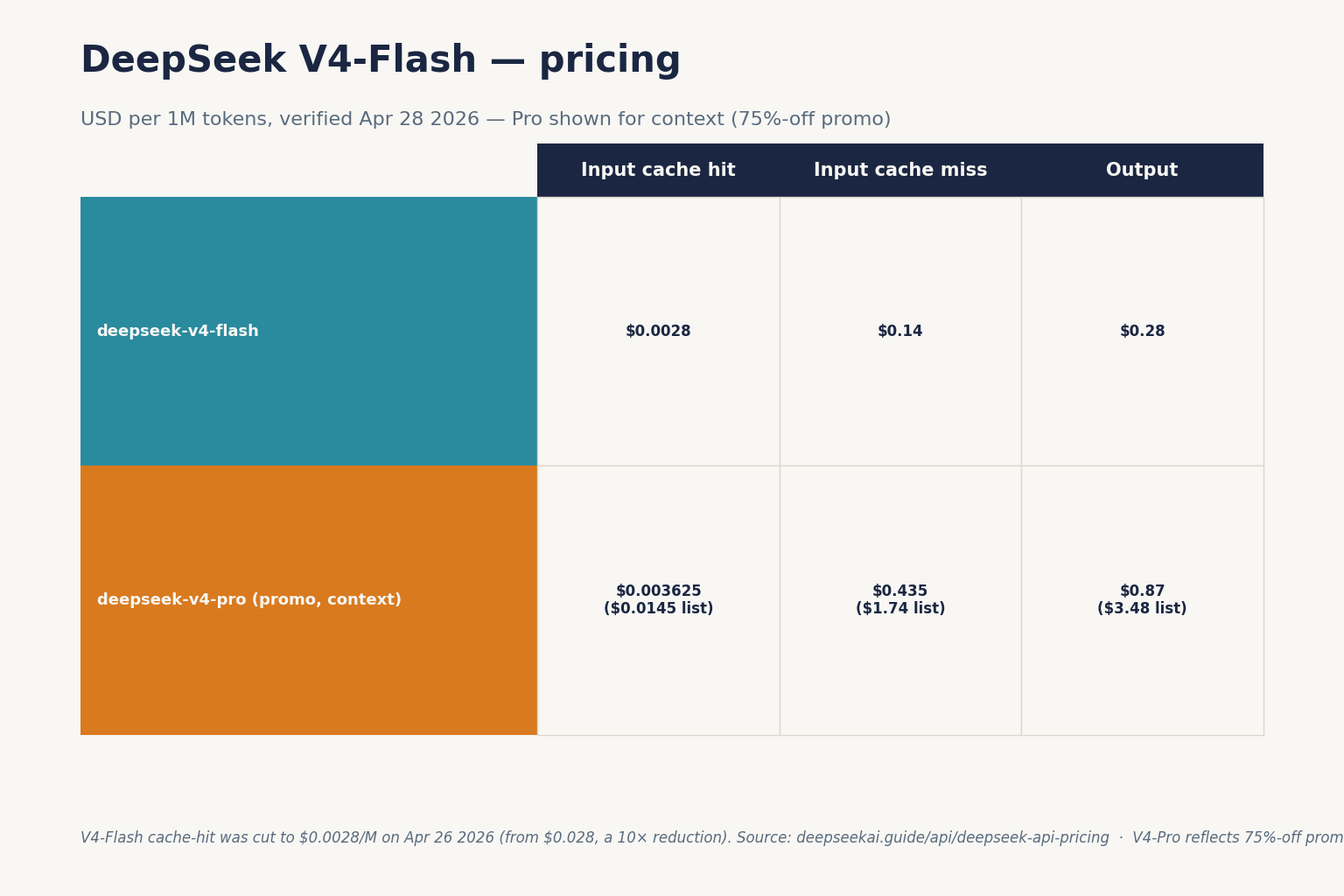
| Bucket | V4-Flash rate | V4-Pro rate (for context) |
|---|---|---|
| Input, cache hit | $0.0028 | $0.003625 promo (list $0.0145) |
| Input, cache miss | $0.14 | $0.435 promo (list $1.74) |
| Output | $0.28 | $0.87 promo (list $3.48) |
Source: DeepSeek V4 Preview release notes, 2026-04-24. DeepSeek is charging $0.14/million tokens input and $0.28/million tokens output for Flash, and $0.435/million input and $0.87/million output for Pro during the 75% promo through 2026-05-31 (list $1.74 / $3.48). Off-peak discounts were discontinued on 2025-09-05 and have not returned with V4. Always verify the current figures on the DeepSeek API pricing page before committing budget.
Worked example — 1M calls on Flash
Scenario: 1,000,000 API calls, each with a 2,000-token system prompt that stays cached across calls, a 200-token user message that is always a cache miss against that prefix, and a 300-token reply.
Cached input:   2,000 × 1,000,000 = 2,000,000,000 tok × $0.0028/M = $5.60
Uncached input:   200 × 1,000,000 =   200,000,000 tok × $0.14/M  = $28.00
Output:           300 × 1,000,000 =   300,000,000 tok × $0.28/M  = $84.00
                                                                   -------
Total                                                              $117.60
The same workload on V4-Pro lands at $355.25 during the 75% promo through 2026-05-31 (and $1,421.00 once the list rates resume) — roughly 3× to 14× more. That is the commercial argument for Flash in one table. For other scenarios, run the numbers with the DeepSeek pricing calculator.
Best use cases for V4-Flash
- Chat and RAG backends where latency and unit cost matter more than the last few points on SWE-Bench.
- Long-document and whole-repo analysis that benefits from the 1M context at Flash’s KV-cache efficiency — see DeepSeek for coding.
- High-volume content and translation pipelines — DeepSeek for writing and DeepSeek for translation.
- Math, formal reasoning, and tutoring — Flash-Max’s Putnam numbers are genuinely strong for the price tier. See DeepSeek for math.
- Internal developer tooling — IDE copilots, code review bots, and agent prototypes where token spend is the deciding factor.
Comparable alternatives
If you are weighing V4-Flash against options outside DeepSeek, the obvious comparisons are DeepSeek vs ChatGPT (for GPT-5-family pricing and model-picker questions) and DeepSeek vs Claude (for agentic coding trade-offs). For a wider sweep of open-weight and API-accessible rivals, the DeepSeek alternatives hub covers Qwen, GLM, Kimi, Llama and Mistral side by side.
Against V4-Pro inside the same family, the decision is mostly budgetary: Flash is roughly a tenth of the output cost with 1–3 points less reasoning performance on most published benchmarks. Pro earns its premium on hard agentic coding and factual-recall work; everywhere else, Flash is the default.
Verdict

DeepSeek V4-Flash is the tier most production teams should run by default in 2026: open-weight, MIT-licensed, 1M context, OpenAI- and Anthropic-compatible, and priced low enough that high-volume workloads stop being a spreadsheet exercise. It is not the top of the current frontier leaderboard — GPT-5.5, Claude Opus 4.7 and Gemini-3.1-Pro remain ahead on the hardest agentic and knowledge tasks — but the price-to-capability ratio is hard to argue with. If you are on deepseek-chat or deepseek-reasoner, swap the model string to deepseek-v4-flash before the July 24, 2026 retirement deadline and move on.
To browse the rest of the family, see the DeepSeek models hub.
DeepSeek AI Guide is an independent resource and is not affiliated with DeepSeek or its parent company. Model IDs, pricing and API behaviour change; check the official DeepSeek documentation and pricing page before committing to a production decision.
Frequently asked questions
What is DeepSeek V4-Flash?
DeepSeek V4-Flash is the cost-efficient tier of the DeepSeek V4 family, released as a preview on April 24, 2026. It is a 284-billion-parameter Mixture-of-Experts model with 13B active per token, a 1M-token context window, and MIT-licensed open weights on Hugging Face. It ships alongside the larger V4-Pro and replaces the older deepseek-chat and deepseek-reasoner endpoints. Full spec breakdown on our DeepSeek V4 page.
How much does DeepSeek V4-Flash cost per million tokens?
As of April 28, 2026, V4-Flash lists at $0.0028 per 1M tokens for cached input (cut 10× from $0.028 on 2026-04-26), $0.14 for uncached input, and $0.28 for output. Those are list prices on the DeepSeek API pricing page and can change during the preview window. The historical off-peak discount that V3.2 offered was discontinued on September 5, 2025 and has not returned with V4.
Is V4-Flash better than V3.2?
On DeepSeek’s reported numbers, yes — Flash is stronger on reasoning and coding benchmarks while using a small fraction of V3.2’s per-token FLOPs and KV cache at 1M context. It is also cheaper per 1M output tokens. The honest caveat is that V4 is still a preview, so independent benchmarks are still arriving. For the older generation details, see our DeepSeek V3.2 page.
Can I run DeepSeek V4-Flash locally?
The weights are on Hugging Face at around 160 GB, MIT-licensed. A full-precision run needs data-centre-class hardware; a quantized build may fit a high-end workstation. DeepSeek recommends temperature = 1.0, top_p = 1.0 for local inference, and at least a 384K context window if you enable Think Max mode. Our install DeepSeek locally guide walks through the setup.
How do I enable thinking mode on V4-Flash?
Thinking mode is a request parameter, not a separate model. On deepseek-v4-flash, set reasoning_effort="high" and pass extra_body={"thinking": {"type": "enabled"}} in the OpenAI SDK call. The response then returns reasoning_content alongside the final content. Use reasoning_effort="max" for the hardest problems. Thinking is enabled by default on V4 — pass extra_body={"thinking": {"type": "disabled"}} for fast non-thinking replies. More patterns in our DeepSeek API code examples.
Sources & Methodology
Primary sources
- OfficialDeepSeek API documentationEndpoints, request/response shape, model IDsLast checked: April 30, 2026
- PricingDeepSeek API pricing pagePer-1M-token rates, billing units, cache-hit pricingLast checked: April 30, 2026
- Model cardDeepSeek on Hugging FaceWeights, license, usage notes per modelLast checked: April 30, 2026
- OfficialDeepSeek V4 Preview release notes (api-docs.deepseek.com)Source for V4-Flash and V4-Pro per-million-token ratesLast checked: April 30, 2026
- Model cardDeepSeek V4 Hugging Face card and technical report (April 2026)DeepSeek-reported V4-Flash and V4-Pro benchmark figuresLast checked: April 30, 2026
Technical references
- Technical reportDeepSeek-V3 technical report (arXiv:2412.19437)V3 architecture and training methodologyLast checked: April 30, 2026
- BenchmarkSWE-Bench Verified leaderboardSoftware-engineering benchmark scoresLast checked: April 30, 2026
- BenchmarkLiveCodeBenchLive coding benchmark scoresLast checked: April 30, 2026
- Technical reportDeepSeek V4 technical reportPutnam-200 81.0, SWE-Bench Verified 79.0/80.6, HMMT 95.2Last checked: April 30, 2026
Methodology
Architecture, parameter counts, context window, and license were checked against the official DeepSeek model card and the corresponding technical report. Benchmark figures are reproduced as they appear in vendor materials and are treated as directional indicators rather than guarantees of real-world performance.
Data confidence
High for official architecture and license; medium for vendor-reported benchmarks; low for projected future capabilities.
Editorial note
Vendor-reported figures are not always independently replicated. Benchmarks at the frontier change quickly; expect this article to need a refresh whenever DeepSeek, OpenAI, Anthropic, or Google ship a new model.