
DeepSeek vs Grok: Which AI Should You Actually Build On?

You are picking between two AI providers that look superficially similar — both ship reasoning-capable models, both undercut OpenAI on token price, both have very loud founders — and you need a straight answer for your stack. This deepseek vs grok comparison is written from production use of DeepSeek V4 and the public xAI API, with every number traceable to a primary source. The short version: DeepSeek V4-Flash is cheaper and open-weight, Grok 4.20 has a bigger context window and tighter X-platform integration, and the right pick depends on whether you value openness or live social data more. Below: a verdict, an at-a-glance table, head-to-head sections, a worked cost example, and clear decision rules.
Verdict: who wins, for whom
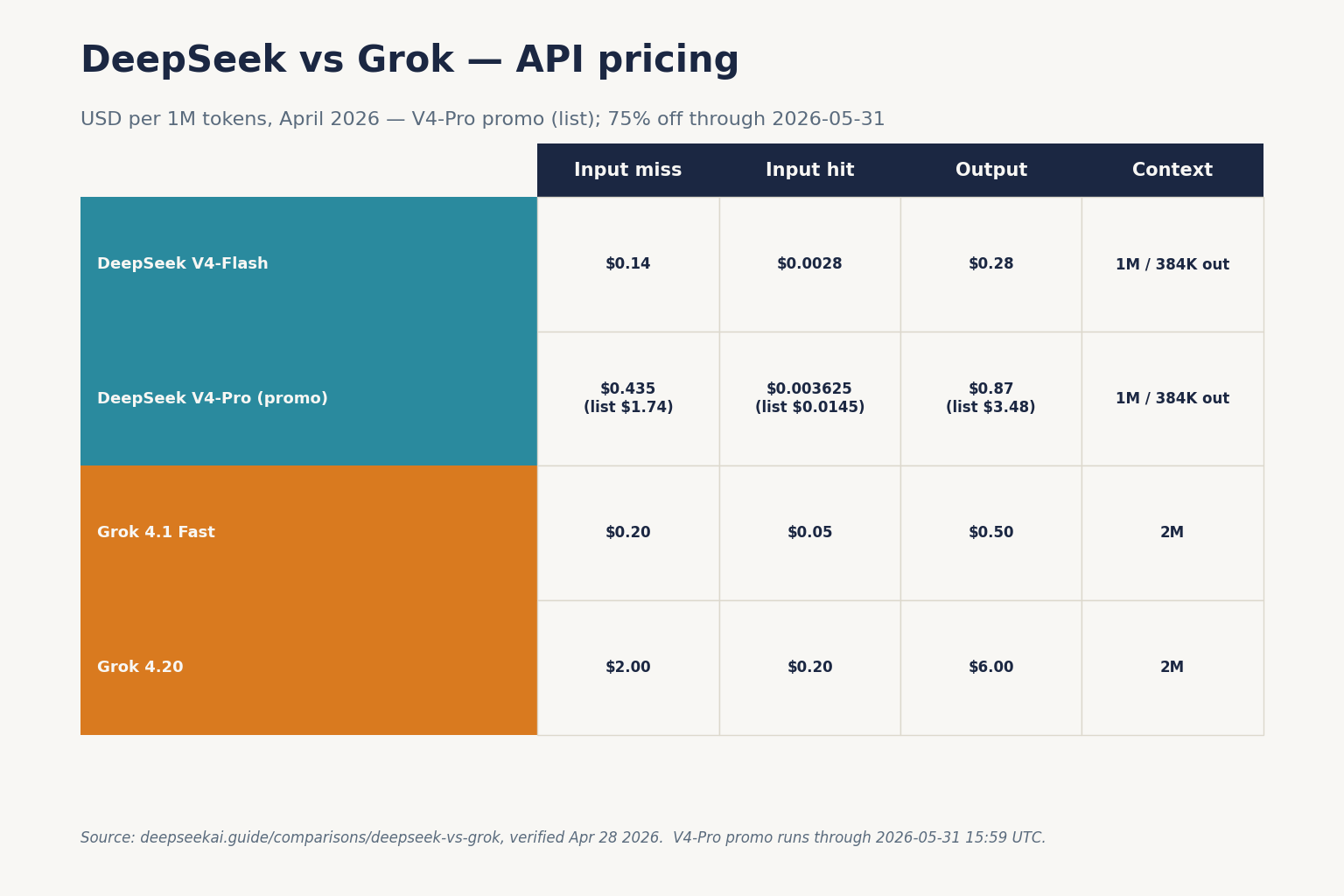
Default to DeepSeek V4-Flash for general-purpose API work. It is open-weight under MIT, supports a 1,000,000-token context with up to 384,000 output tokens, and lists at $0.14 input miss / $0.28 output per 1M tokens — comfortably under Grok 4.1 Fast at $0.20/M input and $0.50/M output. Migration is a one-line OpenAI-SDK swap.
Pick Grok if you specifically need real-time data from X (formerly Twitter), a 2,000,000-token context window, or a single vendor for both chat and X-platform agents. Grok 4.1 Fast has a 2-million-token context window, the largest available across frontier models, and Grok 4 / 4.20 have first-class hooks into X search and the broader xAI tool surface.
Pick DeepSeek V4-Pro over Grok 4.20 only if you need open weights at the frontier tier. Pro is more expensive than V4-Flash but cheaper on output than Grok 4.20 ($0.87 promo / $3.48 list vs $6.00 per 1M output), and it ships under MIT. If on-prem deployment or fine-tuning matters, V4-Pro is the only one of the four with downloadable weights.
At-a-glance: DeepSeek V4 vs Grok 4 family
All prices are USD per 1,000,000 tokens via each vendor’s first-party API. Verified April 2026.
| Model | Input (cache miss) | Input (cache hit) | Output | Context | Weights |
|---|---|---|---|---|---|
| DeepSeek V4-Flash | $0.14 | $0.0028 | $0.28 | 1M / 384K out | Open (MIT) |
| DeepSeek V4-Pro | $0.435 promo (list $1.74) | $0.003625 promo (list $0.0145) | $0.87 promo (list $3.48) | 1M / 384K out | Open (MIT) |
| Grok 4.1 Fast | $0.20 | $0.05 | $0.50 | 2M | Proprietary |
| Grok 4.20 | $2.00 | $0.20 | $6.00 | 2M | Proprietary |
| Grok 4 (legacy flagship) | $3.00 | — | $15.00 | 256K | Proprietary |
What’s current on each side
DeepSeek V4 was released on April 24, 2026 and ships as two open-weight Mixture-of-Experts models: deepseek-v4-pro (1.6T total / 49B active parameters) and deepseek-v4-flash (284B / 13B active). Both expose the same feature set — 1M context, JSON mode, tool calling, streaming, FIM completion (Beta — requires thinking: {"type": "disabled"}), and context caching. For the family overview, see our DeepSeek V4 page.
On the xAI side, the situation is more fragmented. xAI’s docs strongly recommend all API callers use grok-4.20, which they describe as the most intelligent and fastest model they’ve built. Grok 4 remains for frontier reasoning workloads, Grok 4 Fast and Grok 4.1 Fast cover cost-efficient high-volume use, and the previous generation (Grok 3 and Grok 3 Mini) remains available but is no longer xAI’s primary focus. SpaceX announced on January 28, 2026 that it has acquired xAI, which is worth noting because it changes the corporate parent of every Grok product.
Coding
This is the area where the two vendors are closest, and where benchmark figures need the most caveats.
DeepSeek’s V4 announcement reports 80.6 % on SWE-Bench Verified for deepseek-v4-pro; check the DeepSeek benchmarks 2026 roundup for the published splits and the V4 technical report link before quoting. On the Grok side, Vals AI reports Grok Code Fast at 57.6 % on SWE-bench, fourth overall, just behind Grok 4 at 58.6 %, but with a latency of 264.68s compared to Grok 4’s 704.8s. Grok 4’s older marketing pitched a higher number for a “Grok 4 Code” variant — the specialized Grok 4 Code variant posts 72-75 % on SWE-bench, a highly competitive result — but that was the original July 2025 launch claim and the Vals figure is the recent independent retest.
Two practical observations from running both in production:
- For tight inner-loop code suggestions inside an IDE, V4-Flash and Grok 4.1 Fast are roughly interchangeable on quality and very close on price. The deciding factor is usually which one your editor extension already supports — see our DeepSeek with VS Code guide.
- For long-horizon agentic coding (multi-file refactors, repository-wide bug fixes), V4-Pro at $0.87/M output (promo through 2026-05-31; list $3.48) is meaningfully cheaper than Grok 4.20 at $6.00/M output, and you can fine-tune V4-Pro on your codebase because the weights are downloadable. Grok 4.20 weights are not public.
Reasoning
Both vendors expose reasoning as a request-time toggle on the same model rather than a separate model ID. On DeepSeek, set reasoning_effort="high" with extra_body={"thinking": {"type": "enabled"}} on either V4 model, and the response returns reasoning_content alongside the final content. On Grok 4.1 Fast, reasoning can be enabled or disabled using the reasoning enabled parameter in the API, with the same general shape.
Grok’s headline reasoning numbers come from the original Grok 4 launch in 2025. Grok 4 Heavy cleared a new bar on HLE and doubled the nearest rival on ARC-AGI-2; in practical coding (SWE-Bench) it forms a top-tier trio with o3 and Claude Opus 4. Grok 4 ships with a 256K-token context window, always-on “Think” reasoning, and an optional Heavy tier that spins up five Grok 4 agents in parallel for the toughest jobs. The Heavy tier is enterprise-priced at $300 per seat per month.
For pure reasoning quality at lower cost, V4-Flash with thinking enabled is the better default. For maximum reasoning intensity, both V4-Pro reasoning_effort="max" and Grok 4.20 reasoning are credible — pick the one whose price/latency profile matches your workload. We dig deeper into how V4 stacks up against other reasoning models in DeepSeek vs OpenAI o1.
Writing and conversation
This is where Grok has its strongest non-technical pitch. On LMArena’s text arena, the Grok 4.1 thinking configuration (“quasarflux”) holds the highest Elo score among public entries, and the non-thinking Grok 4.1 variant (“tensor”) ranks second. LMArena measures human preference, not exam accuracy, so this tells you Grok’s prose style is well-tuned for chat — it does not tell you Grok will do better on a structured task.
DeepSeek V4’s tone is more neutral and instruction-following, which most product teams prefer for customer-facing applications. If you need a chat persona, Grok edges ahead; for B2B copy, support replies, or anything that needs to sound corporate-safe, V4 is easier to deploy. For long-form writing workflows specifically, see DeepSeek for writing.
Pricing — including the parts most articles skip
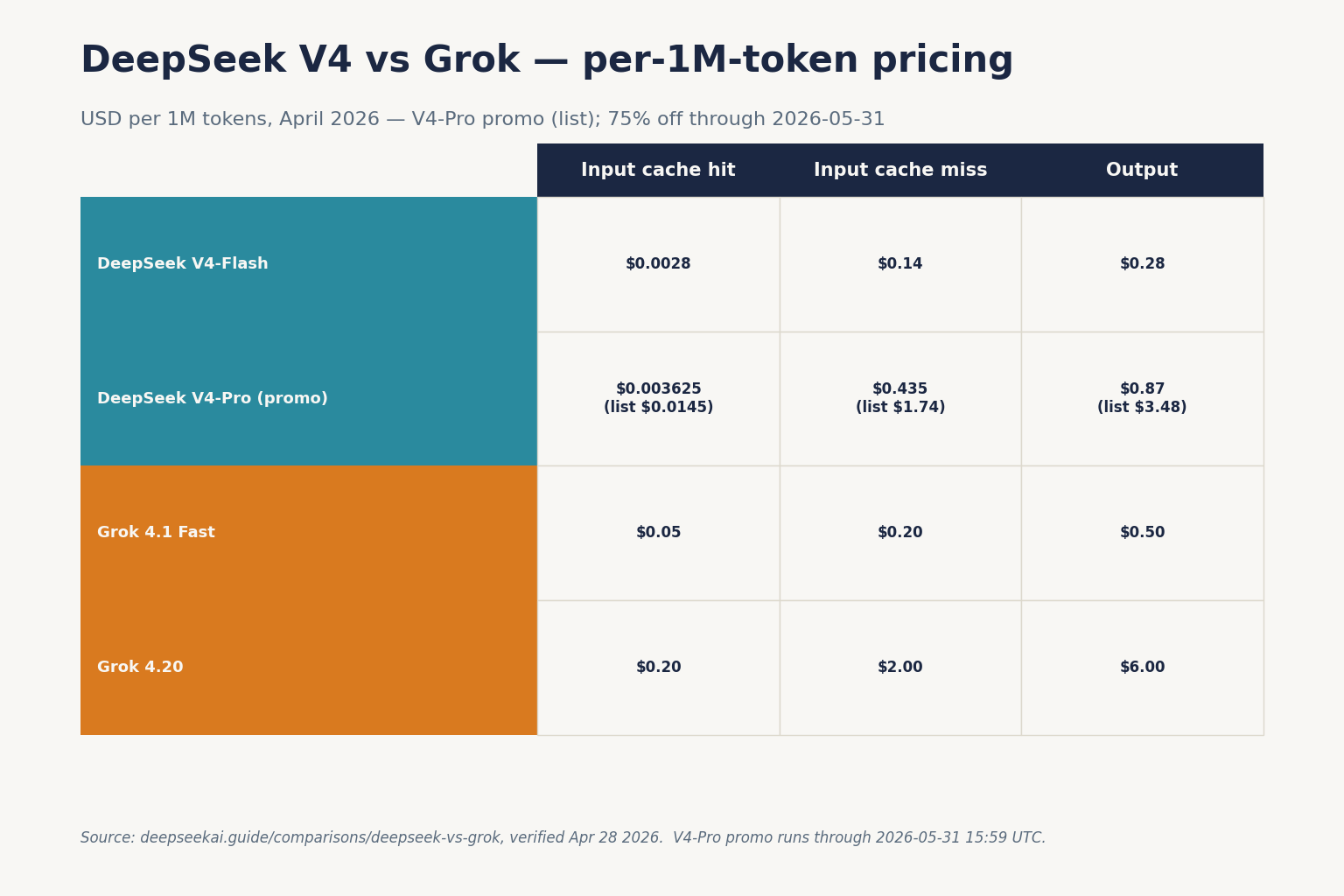
Comparing sticker prices alone is misleading because both vendors have a cache-hit discount and both charge for tools separately.
DeepSeek V4-Flash: $0.0028 cache hit / $0.14 cache miss / $0.28 output per 1M tokens. V4-Pro: $0.003625 / $0.435 / $0.87 during the 75% promo through 2026-05-31 (list $0.0145 / $1.74 / $3.48). Off-peak discounts ended on 2025-09-05 and have not been reintroduced. The full breakdown lives on our DeepSeek API pricing page.
Grok 4.1 Fast: $0.20 per 1M input tokens, $0.05 per 1M cached input tokens, and $0.50 per 1M output tokens, with tool calls starting at $5 per 1,000 successful invocations. Grok 4.20: $2 per million input tokens, $6 per million output tokens, with a 2,000,000-token context window; cache hit drops to $0.20/M (90% off from $2.00). Grok 4 (legacy flagship): $3.00/M input tokens and $15.00/M output tokens.
Two things to watch on the Grok side:
- Built-in tools are billed per call. Web Search, X Search, Code Execution, and Document Search cost $5 per 1,000 calls — easy to overlook when you’re projecting agent costs.
- Grok also allows very large context windows (up to 2 million tokens for Grok 4.x) at specialized pricing ($6.00 input, $30.00 output per million in a big-context mode). The headline price applies to short prompts; once you actually use the 2M window, the rate changes.
Privacy, openness, and data handling
This is where the two diverge most sharply.
DeepSeek publishes V4-Pro, V4-Flash, V3.2, V3.1 and R1 weights on Hugging Face under MIT for both code and weights — you can run them entirely on your own hardware, fine-tune them, or deploy them air-gapped. Some older releases (V3 base, Coder-V2, VL2) split MIT code from a separate DeepSeek Model License for weights; check the specific Hugging Face repo if licensing matters. The flip side is that the hosted DeepSeek API processes your prompts on servers in China, subject to Chinese law. For a deeper look at this trade-off, see DeepSeek privacy.
Grok is fully proprietary. Grok 4.20 weights are not available, and according to Artificial Analysis, xAI has not disclosed the model size or parameter count. Grok models have access to real-time data through X integration, providing current information that models trained on static datasets cannot match — useful for news-monitoring and social-listening, but it also means Grok queries can flow through xAI/X infrastructure with the privacy implications that come with that.
API ergonomics and ecosystem
Both APIs are OpenAI-SDK-compatible, so the integration code is nearly identical. DeepSeek chat requests hit POST /chat/completions, the OpenAI-compatible endpoint, against https://api.deepseek.com. DeepSeek also exposes an Anthropic-compatible surface against the same base URL. The API is stateless — clients must resend conversation history with every request, in contrast to the web/app which maintains session history.
A minimal Python example using the OpenAI SDK against DeepSeek V4-Flash:
from openai import OpenAI

client = OpenAI(
    base_url="https://api.deepseek.com",
    api_key="YOUR_DEEPSEEK_KEY",
)

resp = client.chat.completions.create(
    model="deepseek-v4-flash",
    messages=[{"role": "user", "content": "Summarise this RFP in 5 bullets."}],
    temperature=1.3,
    max_tokens=1024,
)
print(resp.choices[0].message.content)
Set temperature=0.0 for code or maths, 1.0 for data analysis, 1.3 for general chat and translation, and 1.5 for creative writing — DeepSeek’s official guidance.
Grok’s surface is comparable. Function calling, structured output, image input, and streaming all follow the same schema as the OpenAI Chat Completions API; if you’re already using any OpenAI-compatible SDK, switching to Grok is a two-line change. The differences are at the edges: Grok ships first-party Web Search, X Search, code execution and document search as priced tool calls; DeepSeek ships the underlying model and leaves tool orchestration to you (or your framework — see DeepSeek with LangChain).
One legacy note for DeepSeek users: the older deepseek-chat and deepseek-reasoner model IDs currently route to deepseek-v4-flash and will be retired on 2026-07-24 at 15:59 UTC. Migrating is a one-line model= swap; base_url does not change.
When to pick DeepSeek vs when to pick Grok
Pick DeepSeek when
- You want the lowest defensible token price for general chat or RAG (V4-Flash at $0.14 / $0.28).
- You may need to self-host or fine-tune (open MIT weights).
- You want a 1M-context window with 384K output for long document generation.
- Your buyers care about model provenance and want a documented technical report.
Pick Grok when
- You specifically need a 2M-token context window in production.
- Real-time access to X data is core to your product (social listening, news, finance).
- You want xAI’s first-party tool surface (Web Search, X Search, code execution) without wiring it yourself.
- Your users are already inside the X ecosystem and you want a single vendor relationship.
Worked example: 1,000,000 API calls a month
Assume a 2,000-token system prompt (cached after the first call), a 200-token user message (uncached miss against the prefix), and a 300-token response. Same workload, four price columns. Tool-call fees are excluded — add them separately if you use built-in tools.
DeepSeek V4-Flash
- Cached input: 2,000 × 1,000,000 = 2,000,000,000 tokens × $0.0028/M = $5.60
- Uncached input: 200 × 1,000,000 = 200,000,000 tokens × $0.14/M = $28.00
- Output: 300 × 1,000,000 = 300,000,000 tokens × $0.28/M = $84.00
- Total: $117.60
DeepSeek V4-Pro
- Cached input: 2,000,000,000 × $0.003625/M (promo) = $7.25 (list $29.00)
- Uncached input: 200,000,000 × $0.435/M (promo) = $87.00 (list $348.00)
- Output: 300,000,000 × $0.87/M (promo) = $261.00 (list $1,044.00)
- Total: $355.25 (V4-Pro 75% promo through 2026-05-31; list $1,421.00)
Grok 4.1 Fast
- Cached input: 2,000,000,000 × $0.05/M = $100.00
- Uncached input: 200,000,000 × $0.20/M = $40.00
- Output: 300,000,000 × $0.50/M = $150.00
- Total: $290.00
Grok 4.20
- Cached input: 2,000,000,000 × $0.20/M = $400.00
- Uncached input: 200,000,000 × $2.00/M = $400.00
- Output: 300,000,000 × $6.00/M = $1,800.00
- Total: $2,600.00
At this workload, V4-Flash undercuts Grok 4.1 Fast by 60 % and V4-Pro undercuts Grok 4.20 by 45 %. The relationship flips only if your output tokens are very small or your tool-call surface (where Grok ships first-party search) saves you enough engineering time to justify the spend. To run the numbers on your own profile, use the DeepSeek pricing calculator.
Subscription tiers — for end users, not developers

If you’re picking a chatbot to use rather than an API, the comparison is different. Grok offers a free tier with limited daily messages, SuperGrok at $30/month with Grok 4 access, and Grok Business starting at $30/seat/month for teams; you can also access Grok through X platform plans — X Premium ($8/month) and X Premium+ ($40/month) bundle Grok access with X social features. DeepSeek’s web chat at deepseek.com remains free to use without a paid tier as of April 2026; we cover the trade-offs in our DeepSeek free vs paid guide.
Alternatives worth considering
Neither DeepSeek nor Grok is the only option. If neither fits, look at DeepSeek vs Claude for a comparison with Anthropic’s lineup, or DeepSeek vs ChatGPT for the OpenAI side. For a wider scan, our AI comparison hub covers the full set of head-to-heads.
DeepSeek AI Guide is an independent resource and is not affiliated with DeepSeek or its parent company. Model IDs, pricing and API behaviour change; check the official DeepSeek documentation and pricing page before committing to a production decision.
Is DeepSeek cheaper than Grok?
For most workloads, yes. DeepSeek V4-Flash lists at $0.14 input miss / $0.28 output per 1M tokens, while Grok 4.1 Fast costs $0.20/M input tokens and $0.50/M output tokens. At the frontier tier, V4-Pro’s $3.48/M output at list (currently $0.87/M during the 75% promo through 2026-05-31) undercuts Grok 4.20’s $6.00/M output and Grok 4’s $15.00/M output. Tool-call fees on Grok add up separately. Run your own numbers in the DeepSeek pricing calculator.
Does Grok have a bigger context window than DeepSeek?
Yes — at the headline level. Grok 4.1 Fast has a 2,000,000 token context window with maximum output of 30,000 tokens, while DeepSeek V4 ships with a 1,000,000-token context and up to 384,000 output tokens on both Pro and Flash. For very long inputs Grok wins on input size; for very long generations DeepSeek wins on output size. See DeepSeek context length checker to compare your prompt against limits.
Can I self-host DeepSeek or Grok?
You can self-host DeepSeek. V4-Pro, V4-Flash, V3.2, V3.1 and R1 ship with both code and weights under MIT on Hugging Face. Grok is proprietary — Grok 4.20 is proprietary, the model weights are not publicly available, and xAI has not disclosed the model size or parameter count. If self-hosting matters, follow our install DeepSeek locally guide.
How does Grok’s reasoning mode compare to DeepSeek’s thinking mode?
Both expose reasoning as a per-request parameter rather than a separate model. DeepSeek V4 returns reasoning_content alongside the final content when you set reasoning_effort="high" with thinking enabled. On Grok 4.1 Fast, reasoning can be enabled or disabled using the reasoning enabled parameter in the API. Behaviour differs in detail; for the DeepSeek side see DeepSeek API documentation.
Why would I pick Grok over DeepSeek?
Three reasons make Grok the right call: real-time X data, the 2M-token context window, and xAI’s first-party tool surface (Web Search, X Search, code execution) billed at $5 per 1,000 calls. The Grok 4 Fast line, and now Grok 4.1 Fast, represents xAI’s attempt to combine competitive capability with aggressive token pricing. For everything else — open weights, lower per-token cost, larger output budget — see our DeepSeek vs competitors review.
Sources & Methodology
Primary sources
- OfficialDeepSeek API documentationEndpoints, request/response shape, model IDsLast checked: April 30, 2026
- PricingDeepSeek API pricing pagePer-1M-token rates, billing units, cache-hit pricingLast checked: April 30, 2026
- Model cardDeepSeek on Hugging FaceWeights, license, usage notes per modelLast checked: April 30, 2026
- PricingAnthropic Claude pricingClaude API rates for cross-vendor comparisonsLast checked: April 30, 2026
- PricingOpenAI API pricingOpenAI API rates for cross-vendor comparisonsLast checked: April 30, 2026
Technical references
- Technical reportDeepSeek-V3 technical report (arXiv:2412.19437)V3 architecture and training methodologyLast checked: April 30, 2026
- Technical reportDeepSeek-R1 paper (arXiv:2501.12948)R1 reasoning approach, distillation resultsLast checked: April 30, 2026
- BenchmarkSWE-Bench Verified leaderboardSoftware-engineering benchmark scoresLast checked: April 30, 2026
Context sources
- BenchmarkVals AI leaderboard: Grok 4 / Grok Code Fast SWE-benchIndependent retest of Grok SWE-bench scores and latenciesLast checked: April 30, 2026
- AnalysisArtificial Analysis: Grok 4.20 model-disclosure notexAI has not disclosed Grok 4.20 size/parameter countLast checked: April 30, 2026
Methodology
Pricing was normalised per 1 million input and output tokens against each vendor's official pricing page on the review date. Benchmark scores were treated as directional indicators, not guarantees of real-world performance. Practical comparisons also weighed coding, reasoning, summarisation, and developer-workflow scenarios.
Data confidence
High for official pricing and feature presence; medium for cross-vendor benchmark comparisons; low for subjective workflow verdicts.
Editorial note
Pricing and model line-ups change frequently in this market. The verdicts here are calibrated for the date shown above and should be re-checked before final purchasing decisions.