
The Best DeepSeek Alternatives for Coding Tested Head-to-Head

You ship code for a living. DeepSeek-V4 just landed on April 24, 2026 with strong SWE-Bench numbers and aggressive pricing, but it is not the only credible option, and on some workloads it is not even the best. So which DeepSeek alternatives for coding are actually worth wiring into your editor, your CI, or your agent harness right now?
This guide compares seven serious contenders — Claude Sonnet 4.6, Claude Opus 4.7, GPT-5.2-Codex / GPT-5.5, Gemini 3.1 Pro, Qwen3-Coder, GLM-5.1, and GitHub Copilot — against DeepSeek V4 on the metrics that decide real engineering work: SWE-Bench Verified, Terminal-Bench 2.0, context window, price per million tokens, and editor integration. You will leave with a defensible pick for your specific use case.
How we picked the alternatives

We restricted the field to models that meet three criteria: they are generally available (or in public preview) as of April 25, 2026; they have a published SWE-Bench Verified score from a primary source; and they are realistically wireable into a modern coding workflow — IDE plugin, CLI agent, or OpenAI-compatible API. We ran each through a mix of refactoring, bug-fix, and multi-file agent tasks against our usual baseline, DeepSeek V4-Pro and DeepSeek V4-Flash.
Where we cite a benchmark, we link the source and quote the model version that produced the number. Where pricing changes weekly (it does in this market), we link the live pricing page and date the snapshot.
At-a-glance comparison table
The table below is the headline view. Read the per-model sections below for the caveats — particularly around benchmark harness, mode (thinking vs non-thinking), and whether the price covers cached or uncached input.
| Model | SWE-Bench Verified | Context | Input $/1M | Output $/1M | Open weights |
|---|---|---|---|---|---|
| DeepSeek V4-Pro | 80.6 | 1M | $0.435 promo / $1.74 list | $0.87 promo / $3.48 list | MIT |
| DeepSeek V4-Flash | 79.0 | 1M | $0.14 | $0.28 | MIT |
| Claude Opus 4.7 | 82.0 | 1M (beta) | $5 | $25 | No |
| Claude Sonnet 4.6 | 79.6 | 1M | $3 | $15 | No |
| GPT-5.4 (Codex family) | 78.2 | ~1M | varies | varies | No |
| Gemini 3.1 Pro | 78.8 | 1M | ~$2 | ~$12 | No |
| Qwen3-Coder-480B | >70 | 256K | varies | varies | Apache 2.0 |
| GLM-5.1 | ~74 | ~200K | varies | varies | Open weights |
1. Claude Sonnet 4.6 — the default for most teams
If we had to recommend one drop-in alternative for engineering teams already happy paying frontier prices, this is it. Anthropic released Claude Sonnet 4.6 on February 17, 2026, scoring 79.6% on SWE-bench Verified and 72.5% on OSWorld — within 1-2 points of Opus 4.6. Pricing stays at $3 per million input tokens and $15 per million output tokens.
The case for Sonnet 4.6 over DeepSeek V4-Pro is reliability rather than benchmark dominance: on SWE-bench Verified, Sonnet 4.6 is 79.6% vs Opus 4.6 at 80.8%; on OSWorld-Verified, Sonnet 4.6 is 72.5% vs Opus 4.6 at 72.7% — near-parity on agentic coding and computer-use automation. The case against: at $15 per million output tokens it is roughly 4× the cost of V4-Pro and over 50× the cost of V4-Flash on output-heavy agent loops.
2. Claude Opus 4.7 — top of the SWE-Bench leaderboard, but expensive
For teams where the marginal point of accuracy on long, hard tasks justifies a 5× spend over Sonnet, Opus is the current ceiling. Claude Opus 4.7 leads SWE-bench at 82.00%, with Gemini 3.1 Pro Preview at 78.80% and Claude Opus 4.6 (Thinking) and GPT 5.4 tied at 78.20%.
Real-world pricing surfaces matter here too. GitHub has been tightening Opus access: restricting Claude Opus 4.7 to the more expensive $39/month “Pro+” plan, and dropping the previous Opus models entirely. If you mostly work through Copilot rather than the raw API, expect to pay for the Pro+ tier or fall back to Sonnet.
3. GPT-5.2-Codex and GPT-5.5 — the GitHub Copilot pick
OpenAI’s coding-tuned models are the strongest alternative if your workflow is built around Codex CLI or Copilot. GPT-5.2-Codex is generally available to Copilot Enterprise, Copilot Business, Copilot Pro, and Copilot Pro+. The successor landed the same day as DeepSeek V4: GPT-5.5 is now rolling out on GitHub Copilot, launching with a 7.5× premium request multiplier as part of promotional pricing.
Two warnings. First, on raw SWE-Bench, the GPT-5 family sits behind both Opus 4.7 and DeepSeek V4-Pro on Vals AI’s April 24, 2026 leaderboard. Second, Copilot is going through a pricing reshuffle: starting April 20, 2026, new sign-ups for Copilot Pro, Copilot Pro+, and student plans are temporarily paused. Existing subscribers are unaffected, but new individual purchases hit a wall right now. For a deeper breakdown, see DeepSeek Coder vs Copilot.
4. Gemini 3.1 Pro — strong on long-context coding
Gemini quietly closed the SWE-Bench gap. Gemini 3.1 Pro Preview (02/26) follows at 78.80%, with Claude Opus 4.6 (Thinking) and GPT 5.4 tied at 78.20%. Where it earns its spot in this list is the combination of a 1M-token context with Google’s pricing — closer to V4-Pro than to Opus on output, while staying inside a familiar SDK. If your codebase is one big monorepo and you want to feed half of it into a single prompt, Gemini and DeepSeek V4 are the two natural picks.
5. Qwen3-Coder — the open-source workhorse
For teams who care about open weights and self-hosting, Qwen3-Coder is the closest thing to a drop-in for the V4-Flash tier. Qwen3-Coder-Next achieves over 70% on SWE-Bench Verified using the SWE-Agent scaffold, with competitive performance across multilingual settings and the more challenging SWE-Bench Pro benchmark. The bigger Qwen3-Coder-480B variant lands around 38.7% on SWE-Bench Pro per Scale’s leaderboard, against DeepSeek V3.2’s 15.6% on the same harness.
The trade-off is hosting. Qwen 3.6 Plus is the most cost-effective model at frontier-adjacent performance, and leads outright on Terminal-Bench 2.0 agentic coding — the default “good enough, dramatically cheaper” option in 2026. Compare against DeepSeek vs Qwen for the head-to-head.
6. GLM-5.1 — the agentic-coding dark horse
GLM-5.1 from Zhipu landed on the Terminal-Bench 2.0 board ahead of GPT-5.4 and Kimi on certain agent tasks per DeepSeek’s own V4 release notes — V4-Pro at max reasoning effort scores 67.9 on Terminal Bench 2.0, ahead of GLM-5.1 (63.5) and K2.6 (66.7), behind GPT-5.4-xHigh (75.1) and Gemini-3.1-Pro (68.5). If you want to compare directly, our DeepSeek vs GLM deep dive walks through the agent-harness differences.
7. GitHub Copilot — the integration play, not the model play
Copilot is not a model; it is a routing layer. Free, Pro and Pro+ plans expose Anthropic Claude Haiku 4.5, Sonnet 4.5, Sonnet 4.6, Opus 4.5, 4.6 and 4.7, plus Google Gemini 2.5 Pro, Gemini 3 Flash and 3.1 Pro previews, OpenAI GPT-5 mini, GPT-5.2, GPT-5.2-Codex, GPT-5.3-Codex, GPT-5.4, GPT-5.4 mini, and xAI Grok Code Fast 1. The pitch over a raw DeepSeek API call is editor integration, not model quality. Pick Copilot if you want one bill and one extension; pick a direct API if you want to control cost or use V4-Flash specifically.
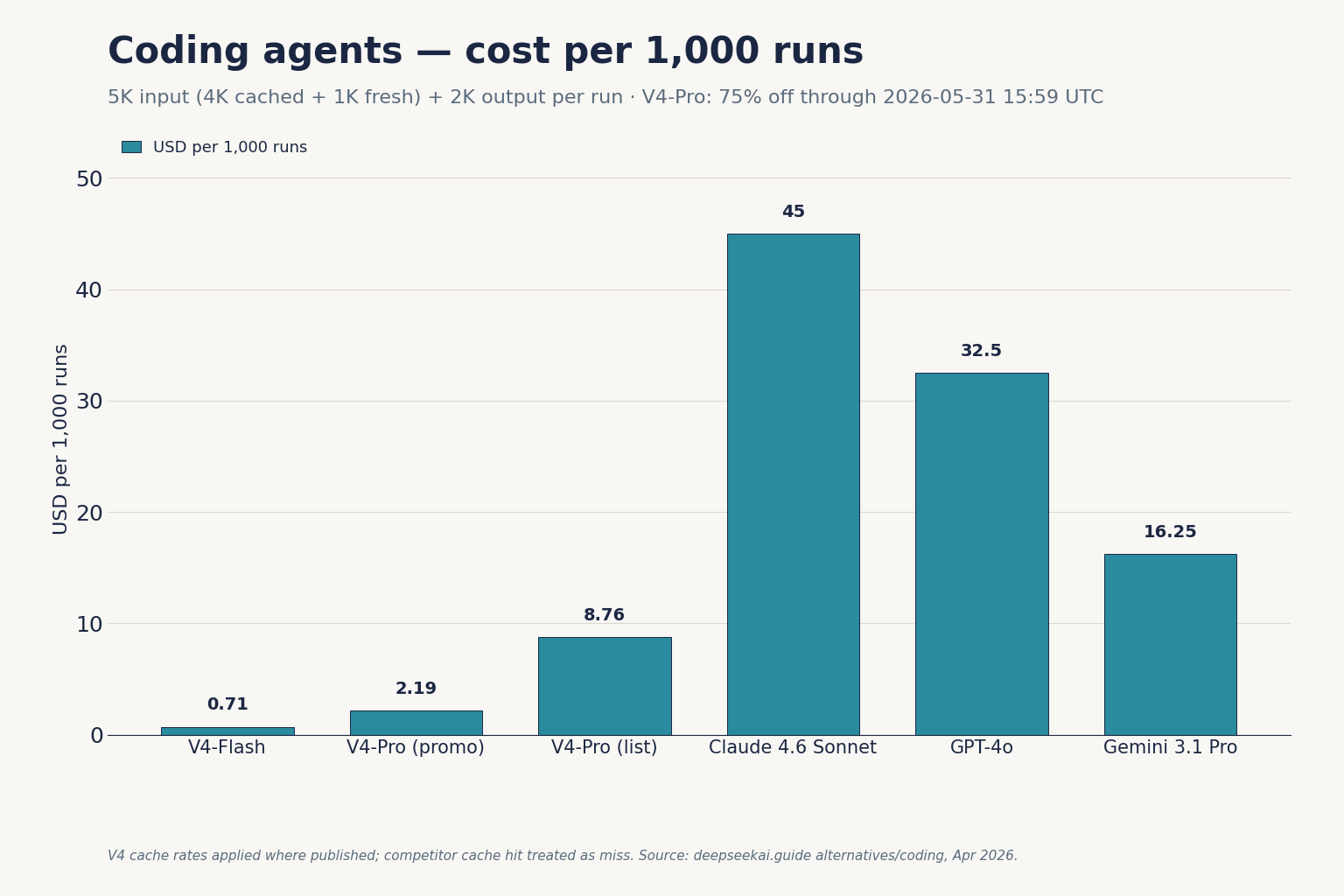
Worked example: cost per 1,000 agent runs

Numbers in the abstract do not help. Here is the same workload — a 2,000-token cached system prompt, a 200-token user message, and a 300-token response, run 1,000,000 times — across three rate cards. Endpoint in every case is POST /chat/completions, which DeepSeek exposes at the OpenAI-compatible base URL.
Workload on DeepSeek V4-Flash:
Input cache hit  : 2,000,000,000 tokens × $0.0028/M = $5.60
Input cache miss :   200,000,000 tokens × $0.14/M  = $28.00
Output           :   300,000,000 tokens × $0.28/M  = $84.00
Total                                              = $117.60
Same workload on DeepSeek V4-Pro:
Input cache hit  : 2,000,000,000 tokens × $0.0145/M = $29.00
Input cache miss :   200,000,000 tokens × $1.74/M (list)  = $348.00
Output           :   300,000,000 tokens × $3.48/M (list)  = $1,044.00
Total                                              = $1,421.00 list (or $355.25 during the 75% V4-Pro promo through 2026-05-31)
Same workload on Claude Sonnet 4.6 at the published $3 input / $15 output, ignoring caching for a worst-case ceiling: $1,200 input + $4,500 output = $5,700. Even on Claude’s batches discount that lands well above V4-Pro. The pricing gap is what makes V4-Flash a natural default for high-volume background agents and Sonnet 4.6 a reasonable default for interactive IDE work where you want predictable behaviour. For your own scenarios, plug numbers into the DeepSeek cost estimator.
How to wire DeepSeek into your editor in five minutes
If you want to test V4 against your shortlist before committing, the cheapest way in is the API. The example below uses the OpenAI Python SDK against DeepSeek; chat requests hit POST /chat/completions, the OpenAI-compatible endpoint at https://api.deepseek.com. DeepSeek also exposes an Anthropic-compatible surface against the same base URL.
from openai import OpenAI

client = OpenAI(
    base_url="https://api.deepseek.com",
    api_key="sk-...",
)

resp = client.chat.completions.create(
    model="deepseek-v4-pro",
    messages=[{"role": "user", "content": "Refactor this module to use asyncio."}],
    temperature=0.0,            # deterministic for code
    max_tokens=8000,
    reasoning_effort="high",
    extra_body={"thinking": {"type": "enabled"}},
)
print(resp.choices[0].message.content)
The current generation is DeepSeek V4, shipped as two model IDs: deepseek-v4-pro (1.6T total / 49B active) and deepseek-v4-flash (284B / 13B active). Both are open-weight MoE under the MIT license. Thinking mode is a request parameter on either model — set reasoning_effort="high" with extra_body={"thinking": {"type": "enabled"}} for thinking, or default is thinking-enabled — pass extra_body={"thinking": {"type": "disabled"}} for non-thinking (faster, cheaper). When thinking is enabled the response returns reasoning_content alongside the final content.
If you maintain older code that targets deepseek-chat or deepseek-reasoner, those legacy IDs still work — they currently route to deepseek-v4-flash — but they retire on 2026-07-24 at 15:59 UTC. Migration is a one-line model= swap; base_url does not change. The API itself is stateless: every request must resend the full message history, unlike the web/app which keeps session state for you. For the long version, see the DeepSeek API documentation or the DeepSeek API getting started tutorial.
Decision tree: which alternative fits which job
- Highest accuracy, cost insensitive: Claude Opus 4.7 leads SWE-Bench Verified at 82.00%. Default to Opus for hard, infrequent tasks; pair it with cheaper models for everything else.
- Best value at frontier-adjacent quality: Claude Sonnet 4.6 at $3/$15 per million tokens, or DeepSeek V4-Pro at $0.435/$0.87 promo through 2026-05-31 (list $1.74/$3.48). V4-Pro wins on price; Sonnet wins on tooling maturity.
- Cheapest scaled inference: DeepSeek V4-Flash at $0.14/$0.28 per million tokens. Nothing on the closed-source side is close at this benchmark tier.
- Open weights for self-hosting: Qwen3-Coder for SWE-Bench parity at small active-parameter counts, or DeepSeek V4 if you have the GPUs for a 1.6T MoE.
- Tight IDE integration without API plumbing: GitHub Copilot Pro at $10/month, with the caveat that new sign-ups are paused as of April 20, 2026.
- Long-context monorepo work: DeepSeek V4 (1M default), Gemini 3.1 Pro (1M), or Sonnet 4.6 in 1M beta.
Where DeepSeek still wins on coding

Two areas. First, raw price-performance — a 1.6 trillion parameter open-source model that scores 80.6% on SWE-bench Verified, within 0.2 points of Claude Opus 4.6 — and costs $0.87 promo / $3.48 list per million output tokens versus Claude’s $25, a 29x promo / 7x list price gap at near-identical coding benchmark performance. Second, at 1M tokens, DeepSeek-V4-Pro requires 27% of single-token inference FLOPs compared with DeepSeek-V3.2 and uses 10% of the KV cache memory; V4-Flash drops these even further to 10% of the FLOPs and 7% of the KV cache. That matters if you self-host long agent traces.
Where DeepSeek loses: tooling polish (Cursor and Claude Code remain ahead), and frontier-tier reasoning on the hardest non-coding evals — HLE at 37.7% puts V4-Pro below Claude (40.0%), GPT-5.4 (39.8%), and well below Gemini-3.1-Pro (44.4%). For most coding workloads, that gap doesn’t matter; for cross-domain agent work it can.
Our pick
For pure SWE-Bench leadership, Claude Opus 4.7. For the best balance of quality, ecosystem, and price among closed models, Claude Sonnet 4.6. For the best balance overall — including price, openness, and 1M context — DeepSeek V4-Pro for hard tasks and V4-Flash for everything else. Most teams should run a small bake-off across two models, not commit blind to one. Browse the full DeepSeek alternatives hub for adjacent comparisons (writing, reasoning, research).
DeepSeek AI Guide is an independent resource and is not affiliated with DeepSeek or its parent company. Model IDs, pricing and API behaviour change; check the official DeepSeek documentation and pricing page before committing to a production decision.
What is the best DeepSeek alternative for coding in 2026?
It depends on your constraint. For peak SWE-Bench Verified accuracy, Claude Opus 4.7 leads with 82.00%. For best value at frontier-adjacent quality, Claude Sonnet 4.6 at $3/$15 per million tokens. For tight IDE integration, GitHub Copilot. We compare these head-to-head in our DeepSeek vs Claude breakdown.
How does DeepSeek V4 compare to Claude Sonnet 4.6 for coding?
Roughly equivalent on SWE-Bench Verified — DeepSeek V4-Pro scores 80.6 versus Sonnet 4.6’s 79.6% — but V4-Pro is roughly 4× cheaper on output tokens and ships with open weights under MIT. Sonnet wins on tooling maturity (Claude Code, MCP ecosystem). See the full DeepSeek vs Claude comparison.
Can I use Qwen3-Coder instead of DeepSeek for free?
Yes, if you self-host. Qwen3-Coder ships under Apache 2.0 and Qwen3-Coder-Next achieves over 70% on SWE-Bench Verified using the SWE-Agent scaffold. You pay only for hardware. Hosted API pricing through Alibaba Cloud or third-party gateways is also available. Compare in our free DeepSeek alternatives roundup.
Is GitHub Copilot a better alternative than DeepSeek for VS Code?
For pure editor convenience, yes. Copilot exposes Claude, Gemini and GPT-5 family models in one extension. But starting April 20, 2026, new sign-ups for Copilot Pro, Copilot Pro+, and student plans are temporarily paused, so new buyers may be locked out. The DIY route through DeepSeek with VS Code still works.
Why is DeepSeek V4 so much cheaper than Claude or GPT-5?
Architecture and business model. V4 is a sparse Mixture-of-Experts model — only 49B of the 1.6T parameters activate per token on Pro — and DeepSeek competes on price rather than enterprise margin. Combined with massive efficiency gains: at 1M tokens, V4-Pro requires 27% of single-token inference FLOPs compared with V3.2 and uses 10% of the KV cache memory. See our DeepSeek API pricing guide for the full numbers.
Sources & Methodology
Primary sources
- OfficialDeepSeek API documentationEndpoints, request/response shape, model IDsLast checked: April 30, 2026
- PricingDeepSeek API pricing pagePer-1M-token rates, billing units, cache-hit pricingLast checked: April 30, 2026
- RepositoryDeepSeek-AI on GitHubOpen-weight release details, training/inference notesLast checked: April 30, 2026
- PricingAnthropic Claude pricingClaude API rates for cross-vendor comparisonsLast checked: April 30, 2026
- PricingOpenAI API pricingOpenAI API rates for cross-vendor comparisonsLast checked: April 30, 2026
- PricingGoogle Gemini API pricingGemini API rates for cross-vendor comparisonsLast checked: April 30, 2026
Technical references
- Technical reportDeepSeek-V3 technical report (arXiv:2412.19437)V3 architecture and training methodologyLast checked: April 30, 2026
- BenchmarkSWE-Bench Verified leaderboardSoftware-engineering benchmark scoresLast checked: April 30, 2026
Context sources
- BenchmarkVals AI leaderboard (April 24, 2026)GPT-5 family vs Opus 4.7 / V4-Pro on SWE-BenchLast checked: April 30, 2026
- BenchmarkScale leaderboard: Qwen3-Coder SWE-Bench ProQwen3-Coder-480B SWE-Bench Pro 38.7% vs V3.2's 15.6%Last checked: April 30, 2026
Methodology
Pricing was normalised per 1 million input and output tokens against each vendor's official pricing page on the review date. Benchmark scores were treated as directional indicators, not guarantees of real-world performance. Practical comparisons also weighed coding, reasoning, summarisation, and developer-workflow scenarios.
Data confidence
High for official pricing and feature presence; medium for cross-vendor benchmark comparisons; low for subjective workflow verdicts.
Editorial note
Pricing and model line-ups change frequently in this market. The verdicts here are calibrated for the date shown above and should be re-checked before final purchasing decisions.